

Fragmented information
Dealer information is distributed across local directories, public platforms, and internal records.
Dealer Network Growth
Dealer Network Growth helps manufacturers identify strong dealer candidates, compare market coverage, and monitor the health of active networks.
The platform gives teams one structured view of public market intelligence, dealer reputation, competitive context, and service capability, helping teams research faster, compare and prioritise prospective dealers.
Ask a question
Better dealer decisions
Dealer candidates can be assessed against organization-defined criteria: regional fit, reputation, service capability and competitive alignment.
Faster market research
Dealer information is collected and organized into consistent profiles, reducing the manual work required to evaluate a market.
A clearer market view
Local directories, customer reviews, competitive activity, and other public information are brought together in one place.
More useful dealer data
Dealer Network Growth adds market and reputation indicators that are often missing from traditional CRM records.
The dealer-network challenge
Dealer records are spread across directories, review platforms, company websites, public channels and internal systems. Information quality and availability vary by market. As a result, network-development teams spend time checking records, comparing candidates and deciding which dealers merit further attention. Long lists can increase activity without improving appointment quality.
Challenges
Dealer information is distributed across local directories, public platforms, and internal records.

The depth, quality, and availability of dealer information vary by country, region, and category.

Teams often review dealer websites, customer feedback, product categories, and service capabilities individually.

Traditional dealer lists rarely show which candidates align most closely with the organization’s requirements.

Existing brand relationships and gaps in market coverage can be difficult to identify before outreach begins.

A poorly matched dealer can affect sales coverage, service quality, customer experience, and brand reputation.
Dealer information is distributed across local directories, public platforms, and internal records.
The depth, quality, and availability of dealer information vary by country, region, and category.
Teams often review dealer websites, customer feedback, product categories, and service capabilities individually.
Traditional dealer lists rarely show which candidates align most closely with the organization’s requirements.
Existing brand relationships and gaps in market coverage can be difficult to identify before outreach begins.
A poorly matched dealer can affect sales coverage, service quality, customer experience, and brand reputation.
Dealer information is distributed across local directories, public platforms, and internal records.
The depth, quality, and availability of dealer information vary by country, region, and category.
Teams often review dealer websites, customer feedback, product categories, and service capabilities individually.
Traditional dealer lists rarely show which candidates align most closely with the organization’s requirements.
Existing brand relationships and gaps in market coverage can be difficult to identify before outreach begins.
A poorly matched dealer can affect sales coverage, service quality, customer experience, and brand reputation.
Who Dealer Network Growth supports
Dealer Network Growth supports network-development, channel-strategy, international-expansion and regional teams responsible for dealer coverage and performance. It gives field teams a focused list of dealer candidates, and leadership a clearer view of market coverage, network gaps, and dealer health.
How it works
The organization defines the qualities of a suitable dealer. Dealer Network Growth then uses those requirements to identify, assess, and rank candidates. Criteria can be adapted by market or business priority. When priorities change, the rankings update to reflect them.
The organization establishes the markets, dealer characteristics, service requirements, and commercial criteria used in the assessment.
Dealer Network Growth identifies candidates across selected regions and organizes relevant public information into consistent profiles.
Each candidate is evaluated using available evidence, including reputation, ratings, customer feedback, brands represented, and service capability.
Candidates are ranked according to the organization’s criteria, market-coverage requirements, and strength of available evidence.
Managers review the candidates and approve the dealers selected for outreach.
Approved candidates can be transferred into existing CRM processes for outreach, assessment, and commercial follow-up.
Once appointed, active dealers can be monitored for changes in reputation, customer feedback, and network health.
What Dealer Network Growth delivers
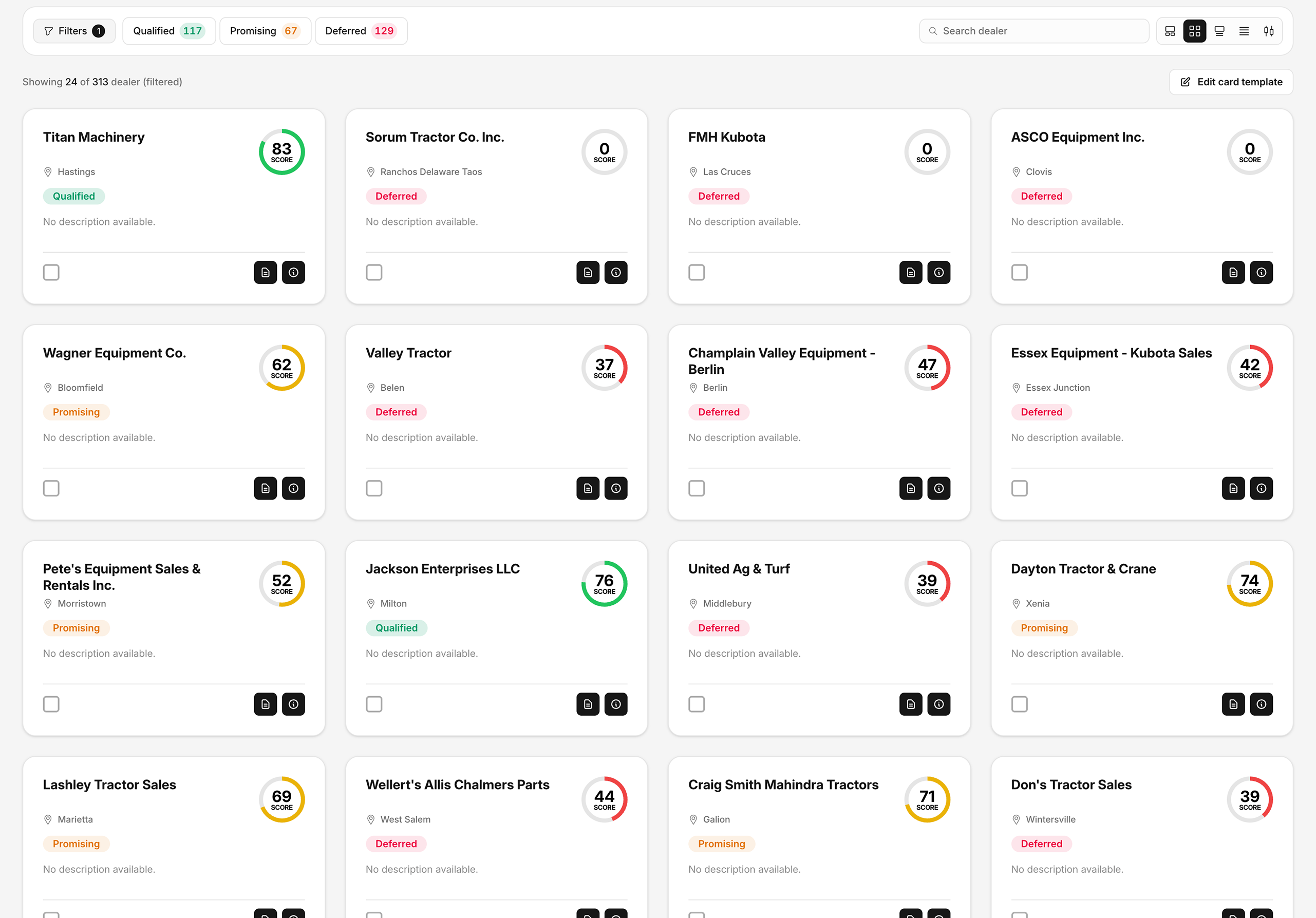
Each candidate appears in a scorecard showing dealer fit, evidence, market position, and areas for review.
After appointment, Dealer Network Growth monitors reputation and customer feedback, flagging repeated complaints, shifting sentiment, or declining service indicators for attention.
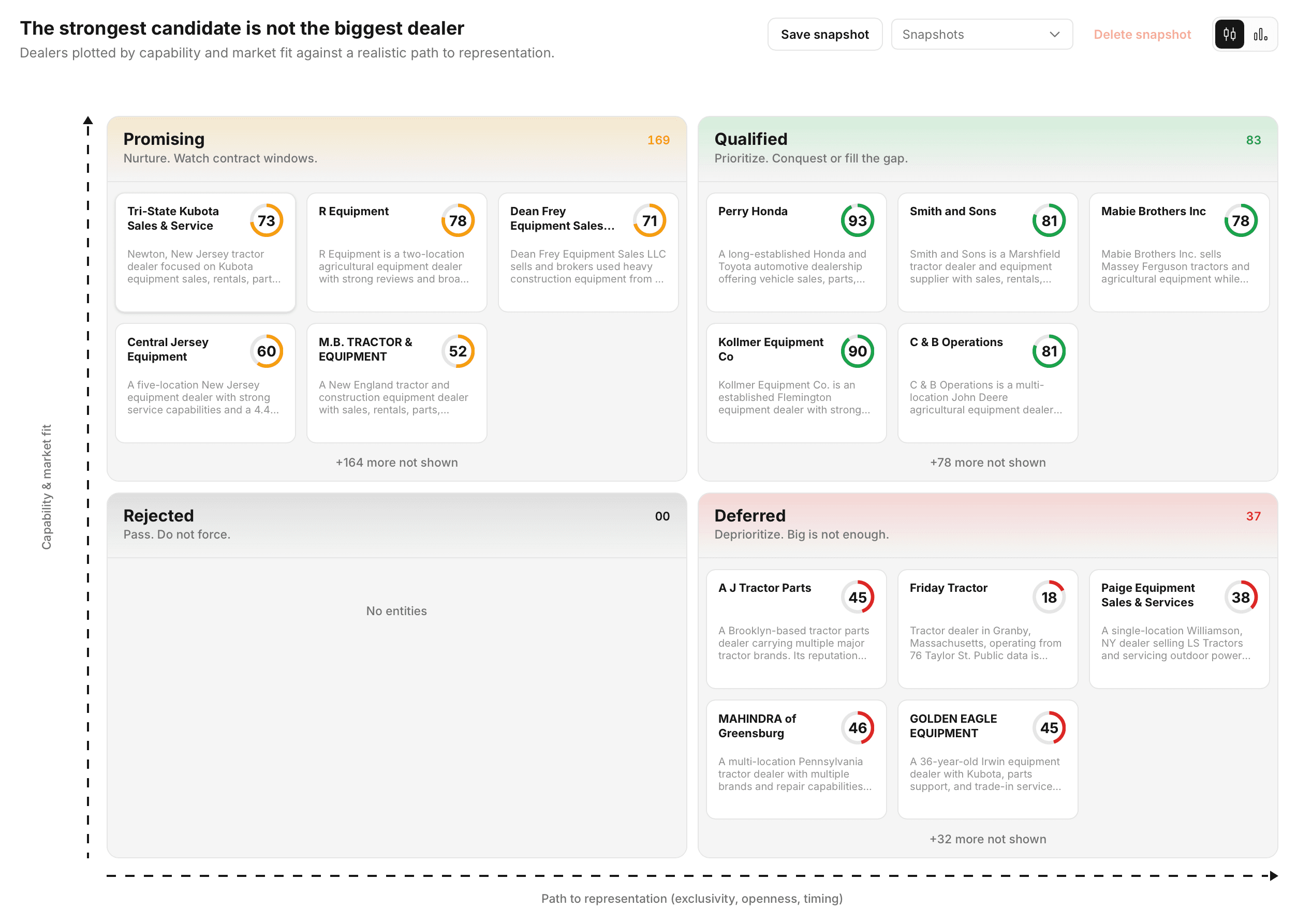
Maps and dashboards show dealer locations, coverage, network health, and gaps, giving leadership a consistent overview and regional teams market-level detail.
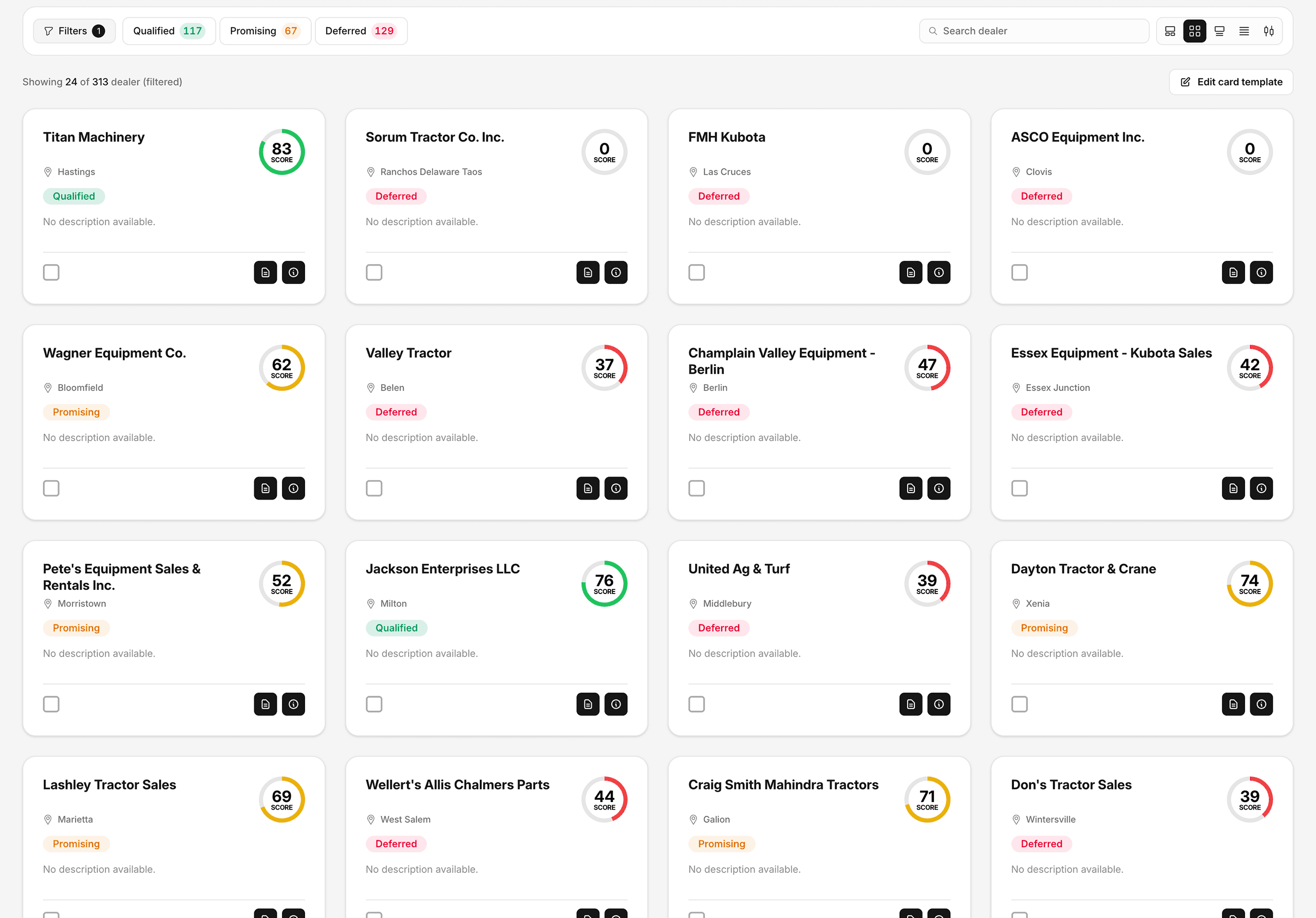
After appointment, Dealer Network Growth monitors reputation and customer feedback, flagging repeated complaints, shifting sentiment, or declining service indicators for attention.
Maps and dashboards show dealer locations, coverage, network health, and gaps, giving leadership a consistent overview and regional teams market-level detail.
Where Dealer Network Growth can be applied
Dealer Network Growth supports manufacturers at different stages of network development, from market entry and dealer recruitment to ongoing performance monitoring.
See it in action
Book a quick demo to see how Dealer Network Growth identifies candidates, compares dealer information, and highlights network opportunities. The conversation can focus on a specific market, network challenge, or growth priority. No preparation is required.